
Regardless of your voting experience or party affiliation, this guide is intended to help South Dakotans make informed decisions in the 2026 primaries and general election. It uses fact-based reporting to fairly and clearly explain the process and who and what is on the ballot.
The guide will be updated as new information becomes available, so bookmark it and share it with family and friends. Send questions, suggestions or corrections to info@sdnewswatch.org. Read all government and political stories, including polls, profiles, ballot issue explanations and other topics.
The next big event is the July 28 runoff election for governor between Gov. Larry Rhoden and Toby Doeden that's open to registered Republicans. Polls will be open statewide from 7 a.m. to 7 p.m. local time.
Important dates and voting basics
When are upcoming deadlines and elections?
Upcoming dates and deadlines for elections, candidate selection, voter registration and voting:
June 6: Democratic state convention in Sioux Falls and election of constitutional officers for general election ballot
June 12: Absentee voting begins for Republican runoff election for governor between Gov. Larry Rhoden and Toby Doeden
June 25-27: Republican state convention in Rapid City and election of constitutional officers for general election ballot
July 13: Deadline to register or change voter registration for Republican gubernatorial runoff election
July 28: Republican gubernatorial runoff election between Gov. Larry Rhoden and Toby Doeden (polls open from 7 a.m. to 7 p.m. local time)
September (dates, times and locations to be determined): Televised town halls on SDPB before the general election
Sept. 18: General election absentee voting begins
Oct. 19: Deadline to register or change voter registration for the general election
Nov. 3: General election (polls are open from 7 a.m. to 7 p.m. local time)
Am I qualified to vote in South Dakota?
To register to vote in South Dakota, you must:
- Be a U.S. citizen
- Live in South Dakota
- Be at least 18 years old on or before next election
- Not be serving a sentence for a felony
- Not be judged mentally incompetent by a court
Can I vote in the next election?
Every registered voter can vote in the November general election and in local elections in June or November. But in the June primary election, a voter is given only the ballot for the party they're registered in, except for voters registered as an Independent or No Party Affiliation (NPA):
- The South Dakota Democratic Primary is open to registered Democrats and Independents/No Party Affiliation voters but not Republicans.
- The South Dakota Libertarian Primary is open to voters registered as Libertarian, Independent or No Party Affiliation.
- The South Dakota Republican Primary is open to only registered Republicans.
How do I check if I'm registered?
First check your current status on the Voter Information Portal that's provided by the Secretary of State and all 66 county auditors.
If you do need to register, you can do it at these places:
- County auditor’s office
- Driver’s license station
- City finance offices
- Public assistance agency, TANF or WIC
- Department of Human Services offices that provide assistance to people with disabilities
- Military recruitment offices
- Download a registration form from the Secretary of State’s website
Here's an FAQ with helpful information and the location of all auditors.
How and when can I vote?
There are three ways to vote in South Dakota state elections:
- To vote in person on Election Day, just go by your assigned polling place on your voter registration card between 7 a.m. to 7 p.m. local time. You may have to stand in line during busy times, but volunteers will walk you through the entire process.
- Early voting is allowed at your county auditor's office during business hours starting 46 days before an election. Staff will help you with the process.
- If you're going to be out of town on Election Day, you can submit an absentee ballot to your county auditor's office starting 46 days before an election.
What do I need to bring with me to vote?
Regardless of how you vote (in person, early or absentee), all voters must show proof of identification or sign a personal identification affidavit at their polling place. Approved forms of photo identification include:
- South Dakota driver's license or nondriver ID card
- U.S. government photo ID such as a passport
- U.S. Armed Forces ID
- Tribal photo ID
- Current student photo identification card from a South Dakota high school or South Dakota accredited institution of higher education
If I didn't vote in the primary election, may I still vote in the general election?
Yes. Just make sure you're registered by the deadline listed in the answer above.
Who and what are on the ballot
Here are the federal and state offices with races in 2026 as well as ballot measures to be considered. Candidates are listed in alphabetical order by last name. Party affiliations are Republican (R), Democratic (D), Independent (I) and Libertarian (L). Incumbents are noted with an asterisk (*).
U.S. Senate
Like all 50 states, South Dakota has two U.S. senators, one of whom is up for re-election this year. Here are the candidates who will meet in the Nov. 3 general election:
- Julian Beaudion (D)
- Brian Bengs (I)
- *Sen. Mike Rounds (R)
U.S. House of Representatives
South Dakota is allocated one congressional seat in the U.S. House of Representatives. Here are the candidates who will meet in the Nov. 3 general election:
- Nicole Gronli (D)
- Marty Jackley (R)
South Dakota governor
South Dakota's governor leads the executive branch of state government in Pierre. Independent candidates are chosen in the November general election, but Democratic and Republican candidates are chosen in the primary election in June.
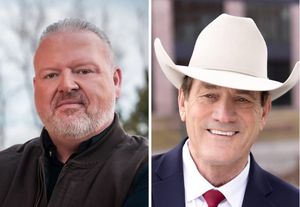
Because none of the four original Republican candidates got 35% of the vote on June 2, these two top vote-getters will meet in a runoff election eight weeks later, on July 28:
- Toby Doeden (R) Read his profile
- *Gov. Larry Rhoden (R) Read his profile
The winner of that contest will meet Democrat Dan Ahlers in the Nov. 3 general election.
Read about the latest campaign finance reports filed by each Republican candidate
Watch the debates involving the four Republicans:
Other executive offices
While voters elect candidates for governor in the primary, political parties choose other state executive candidates at conventions. Here are the offices whose candidates will be chosen in June and appear on the Nov. 3 general election ballot:
Attorney general
Auditor
School and Public Lands commissioner
Lieutenant governor
Public Utilities Commission
Secretary of state
Treasurer
South Dakota Legislature
The South Dakota Legislature is comprised of 105 lawmakers from 35 legislative districts, each of which has one senator and two representatives. Find out which district you live in and also the list of candidates.
Ballot measures on the November ballot
The following "yes/no" ballot measures have been approved for the Nov. 3 general election ballot, all of which were referred by the Legislature. Here is more information about ballot questions on the Secretary of State's website.
Constitutional Amendment I: Expanded Medicaid repeal
Title: An Amendment to the South Dakota Constitution that Repeals Expanded Medicaid Coverage if Federal Funding for the Program Drops below 90%
Attorney general's explanation:
Medicaid is a program, funded by the State and the federal government, to provide medical coverage for low-income children, pregnant women, disabled individuals, and the elderly. In the 2022 General Election the voters approved Constitutional Amendment D, which expanded Medicaid eligibility in South Dakota. Amendment D requires the State to also provide Medicaid benefits to anyone over the age of 18 and under 65 whose income is at or below 133% of the federal property level, plus 5% of the federal poverty level for the applicable family size. Currently, federal law requires the federal government to fund 90% of South Dakota's Medicaid expansion.
This proposed Constitutional Amendment ends the expanded Medicaid coverage if the federal funding for expansion drops below 90%. If federal funding drops below that 90% threshold, Medicaid coverage will once again only apply to low-income children, pregnant women, disabled individuals, and the elderly.
Vote "Yes" to adopt the amendment. Vote "No" to leave the Constitution as it is.
Constitutional Amendment J: Voter citizenship
Title: An Amendment to the South Dakota Constitution Clarifying that an Individual Must Be a Citizen of the United States to be Eligible to Vote
Attorney general's explanation:
Article VII, § 2 of the South Dakota Constitution defines who is qualified to vote in state elections. Among these qualifications are age, residency, and United States citizenship requirements. Article VII, § 2 also establishes that individuals may be disqualified from voting because of mental incompetence or a felony conviction.
This constitutional amendment adds people who are not United States citizens to the list of individuals disqualified from voting, clarifying the existing requirement that only citizens may vote in state elections.
Vote "Yes" to adopt the amendment. Vote "No" to leave the Constitution as it is.
Constitutional Amendment K: Unclaimed property fund
Title: An Amendment to the South Dakota Constitution Establishing the Trust for Unclaimed Property Fund
Attorney general's explanation:
Under South Dakota statute, intangible property is presumed to be abandoned if it remains unclaimed by the owner for more than three years after it became payable or distributable. Examples of intangible property are traveler's checks, money orders, bank deposits, refunds, stocks, funds owed under a life insurance policy, and property held in a safe deposit box. Abandoned intangible property is transferred to the State Treasurer to hold while waiting for the owner to claim it. The State Treasurer must provide public notice of the abandoned property.
This proposed constitutional amendment establishes a trust fund where unclaimed abandoned property will be deposited. Portions of the interest and income from this fund will be distributed into the general fund for the benefit of the state. This proposed amendment requires the Legislature to determine the amount to be distributed that promotes the growth of the trust fund and the distributed amount. is.
Vote "Yes" vote to adopt the amendment. Vote "No" to leave the Constitution as it is.
Constitutional Amendment L: Require 60% to amend Constitution
Title: An Amendment to the South Dakota Constitution Requiring that a Proposed Constitutional Amendment or Revision Receive an Affirmative Vote of Sixty Percent of the Votes Cast
Attorney general's explanation:
The State Constitution provides that any proposed constitutional amendment or revision must be submitted to the voters for approval. Currently, a proposed constitutional amendment or revision becomes part of the Constitution if approved by a majority of the votes cast.
This proposed Constitutional Amendment increases the number of votes required for a proposed constitutional amendment or revision to become part of the Constitution. If passed, further constitutional amendments must receive an affirmative vote of sixty percent of the votes cast to be implemented.
Vote "Yes" to adopt the amendment. Vote "No" to leave as it is.
News Watch's political reporting standards
Here are FAQs about South Dakota News Watch's political reporting standards.
Do South Dakota News Watch’s journalists have a political leaning?
No. We operate with integrity and independence and abide by journalism ethics that require fairness. We explore multiple sides of issues. We aren’t beholden to special interests, public officials, political parties or corporate entities. We don’t produce commentary, editorials or express opinions. And we don’t accept contributions from anonymous donors or elected officials.
How can I trust that your political stories are accurate and fair?
We clearly state who we talked to in each story, only cite credible sources, seek comment from all sides and verify the background of people we interview. Our graphics often include the raw material on which stories are based, so readers can decide for themselves if we got the story right.
How are your political stories different?
Other traditional and new media organizations cover day-to-day developments about politics and government. South Dakota News Watch’s journalists strive to produce in-depth stories that go deeper on important issues. We research and do reporting that explains complex topics that are relevant to people and policymakers. We also conduct scientific polls and public forums that explore what’s on the minds of South Dakotans.
Do you do hit pieces on politicians?
No. The nation’s founders believed a free press was vital to holding elected leaders accountable. Some of those politicians in office now have found it very effective to accuse all news organizations of being biased against them. We believe South Dakota News Watch should be judged on the merits of its own work because its journalists take their role seriously. Donors, all of whom are listed on the website, represent people from across the political spectrum and appreciate that commitment. They are concerned about the state of civics and democracy and appreciate News Watch's independent coverage of politics and government.
Where can I learn more about your standards?
The best practices policies in the website footer spells out all of standards clearly.
Help guide our coverage to better serve South Dakota
We strive to cover issues important to you, but that can be difficult in a large, diverse state. Please fill out this survey and help guide what fact-based news and information we provide to all South Dakotans for free, especially during important election years like 2026. Most of the questions are optional, so can answer only those you have thoughts about. Thank you for your help!
More than 26,000 people read this voter guide in 2024 and thousands more read its content through our media partners. It is a public service that South Dakota News Watch believes in because easy-to-read, fact-based, nonpartisan information is hard to find. Would you consider partnering with us in helping to cover the cost of producing this 2026 version? Thank you!
Sources for this guide include original reporting and publicly available resources provided by the South Dakota Secretary of State's office. It only includes information on statewide and legislative races. Details about local races can be found on each county auditor's website and the state's great local media outlets.
South Dakota News Watch is an independent nonprofit. Read, donate and subscribe for free at sdnewswatch.org. Contact CEO Carson Walker: 605-610-9366/carson.walker@sdnewswatch.org.