Conference places Sioux Falls at "the heartland of the heartland" with theme of America's 250th anniversary.

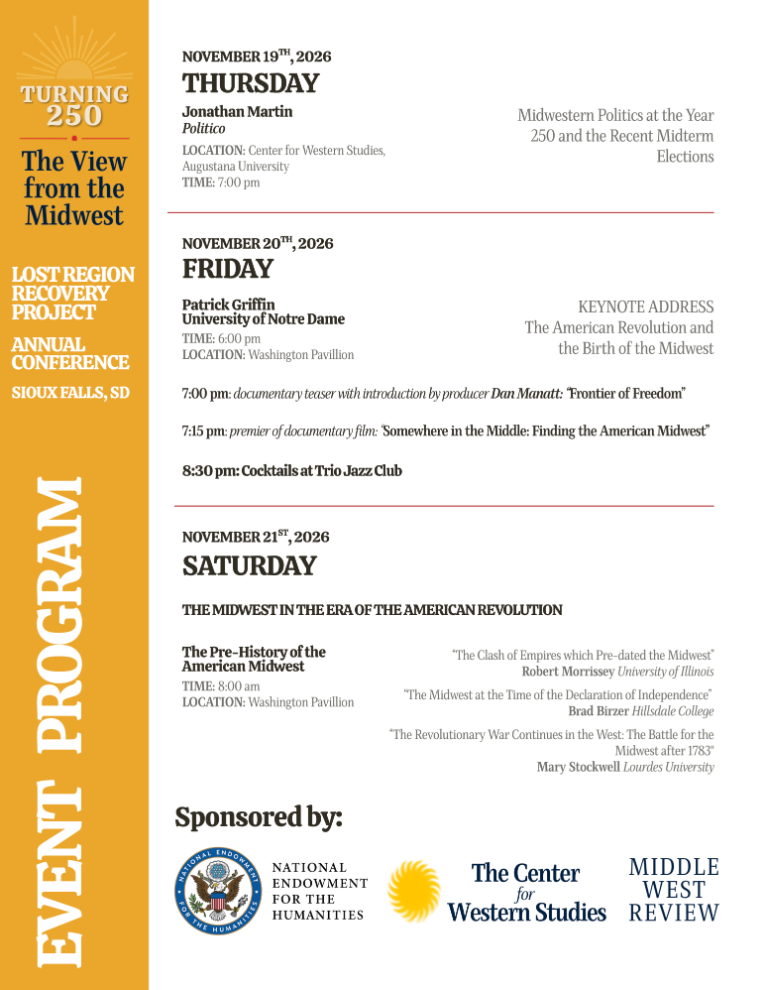
The Lost Region Recovery Project conference will take place in Sioux Falls for the second year in a row, with prominent speakers from historians to journalists giving talks on the history of the Midwest.
Augustana University's Center for Western Studies is a co-sponsor of the event at the Washington Pavilion, along with the National Endowment for the Humanities and the Middle West Review, a publication that focuses on Midwestern history and culture.
Kayle Lauck McCormick, assistant editor of the Middle West Review, said that the name "Lost Region" is intentional, calling focus to the often-forgotten nature of Midwest history and culture.
"We're talking about flyover country and the idea that this is just an insignificant part of the country. And already, the excitement of having young people talking about all of these cool people, cool things that are coming out of this region, shows that that is not the case. That it's not just flyover country or insignificant to the wider national story," McCormick said.
 Molly Wetsch
This year's conference theme is "Turning 250: The View from the Midwest." Jon Lauck, the executive director of the Center for Western Studies and the founder of the Middle West Review, said that having Sioux Falls as the conference's home base for the second year in a row gives opportunities both to the historians of the region and to the city itself.
"I think it's very nice that South Dakota and Sioux Falls and the Center for Western Studies is kind of leading this national effort to put the spotlight on the Midwest and try to get people to focus on it, and bringing speakers here, and I just think we're making a lot of progress," Lauck said.
"I always like spotlighting Sioux Falls, our fair city and our part of the Midwest, and get people thinking about something else besides what the prominent commentators on the coast tell us what we should be thinking about."
The lineup
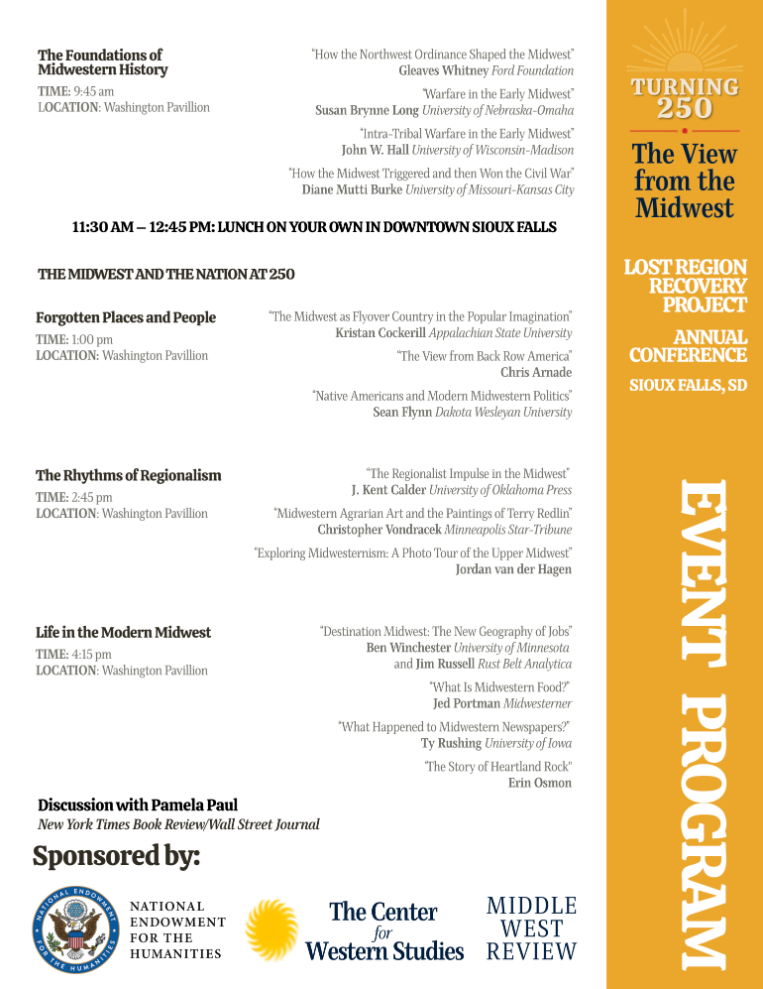
Jonathan Martin, senior political columnist and politics bureau chief at Politico, will speak on Thursday night, discussing Midwestern politics and the recent midterm elections.
"I don't know if there's a more prominent writer on American politics right now than (Martin)," Lauck said.
And on Friday night, attendees will get the chance to see the world premiere of a documentary made by a South Dakota native. Zeke Hanson, a filmmaker from Canton, will show his documentary "Somewhere in the Middle: An Overlooked and Understudied View of the Midwest," which features interviews and archival footage from across the region.
Other sessions include talks about Midwest newspapers, Native Americans in Midwestern politics and a discussion with Pamela Paul, former editor of the New York Times Book Review.
The conference, while focused on history, is also uniquely representative of the Midwest as it stands today: several young people at the helm are promoting and organizing the event. McCormick and Emma Myhre are both graduate students from the Midwest hoping to cast a new light on where they grew up.
McCormick was raised in South Dakota and is now pursuing a joint law and doctorate degree in history at Notre Dame University. Myhre is from Iowa and is studying for a master's degree in archives and public history at New York University.
Myhre said that part of the value of the conference stems from the relative youth of the field, compared to other regions of the country that have long been the subject of academic study.
"What's really exciting about this conference is when you frame it around 'What is the Midwest,' you're framing it around this idea that we really don't know what it is, and it is a region that requires an ongoing, flexible definition," Myrhe said. "So this year, what I think is really exciting, when we look at the story of the United States and we look at the geographic center of it, what does telling that story look like from 250 years?"
Get free, fact-based South Dakota news and information in a weekday email. No spam. Cancel any time.
McCormick, who also helped organize last year's conference, said that getting young people involved in the study of the region is invigorating both for the field and the people involved – and proof that there are still new generations curious about the past.
"I had a lot of fantastic ... and great conversations with young people who are also young academics, early in their careers, who were excited by this idea. Who also felt like there wasn't necessarily a venue at other academic conferences to center this conversation around the region," McCormick said.
"Last year was so spectacular, and especially situating this in celebrating 250 years as a country, what the significance of the region is, and why we should be having these conversations is just exciting. And it's exciting that we get to be the heartland of the heartland."
Jon Lauck said that the Center for Western Studies – which hosts year-round events promoting the history and study of the region – has also helped to defy the "flyover country" narrative that permeates much of the Midwest.
"The whole purpose of a regional studies center is to is to elevate and amplify the culture of the region in which it is located, and to resist the coastal power of our cultural institutions, in which they tell us what movies we should like, and what books we should read, and what books should be published, and what books should get the prizes," he said.
"When you have active cultural regionalists out here standing up for their own culture and their own writers and artists and putting them on the map, I think it makes American pluralism flourish. But if we just sit back and let the coasts decide what our culture should be, I think we're failing ourselves."
South Dakota News Watch is an independent nonprofit. Read, subscribe for free and donate at sdnewswatch.org. Contact reporter/Report for America corps member Molly Wetsch: 605-531-7382/molly.wetsch@sdnewswatch.org.